

How the hurricane deductible works on a Florida policy
We Insure Downtown Miami
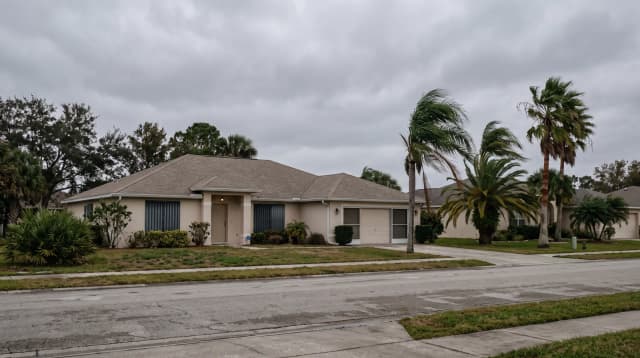
Most Florida property policies carry two deductibles, not one. An ordinary deductible for everyday damage, and a separate hurricane deductible that is written as a percentage of the dwelling limit rather than a fixed amount. The percentage is the part people do not see coming: it moves every time the insured value of the building moves, without anyone changing the policy.
Two deductibles, and the storm decides which one
Which deductible applies is not a judgement call. Section 627.4025(2) of the Florida Statutes defines it.
"Hurricane coverage" is coverage for loss caused by the peril of windstorm during a hurricane — a storm system the National Hurricane Center has declared to be one. And the statute gives that hurricane a clock. The duration of the hurricane, in Florida, begins "at the time a hurricane warning is issued for any part of Florida" by the National Hurricane Center, and ends 72 hours following the termination of the last hurricane watch or hurricane warning issued for any part of Florida.
Three consequences worth holding on to:
- It is statewide. A warning for any part of Florida starts the clock for your property, wherever in Florida it is.
- It runs past the storm. Damage from wind three days after the sky cleared can still fall inside the hurricane window, if the last watch or warning has not yet aged out by 72 hours.
- Interior water can be a hurricane loss. The statute includes ensuing damage inside the building from rain, if the direct force of the windstorm first damaged the building and made an opening the rain came through. Wind first, then water — that is the sequence the statute describes.
Outside that window, wind damage is ordinary wind damage, and the ordinary deductible applies. The date on the claim is doing real work.
The percentage is the whole point
A fixed deductible is a promise about a number. A percentage deductible is a promise about a share — and the thing it is a share of keeps moving.
Under section 627.701(3)(a), the hurricane deductible options are expressed as percentages of the policy dwelling limits. So when the dwelling limit rises, the deductible rises with it, in the same proportion, without anyone deciding anything. Rebuilding costs go up, the limit follows, and the amount you pay before the policy pays anything follows too.
The Legislature was aware of this. Section 627.701(4)(b) requires the insurer to compute and prominently display the actual dollar value of the hurricane deductible on the declarations page at issuance and again at renewal. And 627.701(4)(c) goes further for policies with an inflation guard rider: the insurer must notify the policyholder "of the possibility that the hurricane deductible may be higher than indicated when loss occurs due to application of the inflation guard rider."
Read that last one slowly. It is the statute conceding that the number printed on your page may not be the number that applies on the day. That is the mechanism, stated by the law itself.
What to do with it: find the dollar figure on your declarations page — the law requires it to be there — and check it every renewal. It is the single number on the policy most likely to have changed without a conversation.
What the insurer has to offer you
Before issuing a personal lines residential policy, section 627.701(3)(a) requires the insurer to offer alternative hurricane deductibles equal to $500, 2 percent, 5 percent and 10 percent of the policy dwelling limits — unless the specific percentage deductible would be less than $500.
Two details of that offer that matter more than the list:
- The written notice must specify which hurricane deductible applies if you do not choose one. There is a default, and it is in writing.
- The insurer must give you notice of the available deductibles with each renewal, in a form approved by the Office of Insurance Regulation. Failing to do so is a violation of the insurance code, though the statute says it does not affect the coverage the policy provides.
There is one threshold worth stating precisely, because it is widely repeated wrong. Under 627.701(3)(d)1, for a policy covering a risk with dwelling limits of $250,000 or more, the insurer need not offer the $500 hurricane deductible — but must still offer the others. That is a rule about what the insurer is obliged to put on the table, not a rule about what you are allowed to have.
Once a year, not once a storm
This is the part that surprises people in a busy season, and it works in your favour.
For personal lines residential policies, section 627.701(5)(a)1 says the hurricane deductible "shall apply on an annual basis to all covered hurricane losses that occur during the calendar year" under one or more policies issued by the same insurer or an insurer in the same group. One deductible per calendar year, not one per storm.
What happens on the second hurricane of a year is spelled out too. Under 627.701(5)(a)3, the insurer may apply, for the later storm, the greater of the remaining amount of the hurricane deductible or the deductible that applies to perils other than hurricane. And the same paragraph allows insurers to require policyholders to report hurricane losses that fall below the deductible, or to keep receipts and records of them, in order to apply those losses to a later claim.
That is the actionable sentence of this whole post: a hurricane loss too small to claim is still worth documenting, because it may be what erodes the deductible before the next one. Photograph it, keep the invoices, and ask your carrier how it wants those losses reported.
Two more rules from the same subsection. If you have hurricane losses in one year on more than one policy from the same insurer or group, the deductible is the highest amount stated in any one of them. And if you are offered a lower hurricane deductible after a loss, the insurer must tell you in writing that the lower one does not apply until January 1 of the following calendar year.
For commercial residential policies — the kind a condominium association buys — 627.701(5)(b) requires the insurer to offer both an annual deductible and one that applies to each hurricane. If you sit on a board, that choice is yours to make and it is not the same choice a homeowner faces: high-rise buildings and condominiums.
What the policy itself has to say
Section 627.701(4)(a) requires any policy with a separate hurricane deductible to carry on its face, in boldfaced type no smaller than 18 points:
THIS POLICY CONTAINS A SEPARATE DEDUCTIBLE FOR HURRICANE LOSSES, WHICH MAY RESULT IN HIGH OUT-OF-POCKET EXPENSES TO YOU.
An 18-point warning on the front page is not subtle, and it is there because the Legislature decided this was the provision most likely to be misunderstood. If your policy has one, it is not hidden — but it is easy to file unread.
What this post does not answer
This is an article about how the hurricane deductible works as a mechanism. It is not a reading of your policy and it is not advice on which deductible to choose.
It cannot tell you what yours is: that number is on your declarations page, where the law requires the insurer to compute and display it. It does not cover what the policy pays once the deductible is met, and it does not touch flood, which is a different peril under a different policy with its own deductible: flood insurance.
Questions we get about hurricane deductibles
Does the hurricane deductible apply to every storm?
No — to every hurricane, as the National Hurricane Center defines one, and only within the window that begins with a Florida hurricane warning and ends 72 hours after the last watch or warning. A summer thunderstorm is not in that window.
If a hurricane hits in December and another in the same season, do I pay twice?
For a personal lines residential policy, not twice in full. The deductible applies on an annual basis by calendar year, and for the later storm the insurer may apply the greater of what is left of it or your ordinary deductible.
My deductible went up and nobody told me.
The percentage did not change; what it is a percentage of did. That is exactly why the statute requires the dollar value on the declarations page at issuance and at renewal, and an extra notice if the policy has an inflation guard rider.
Can I choose the lowest one?
You can ask. What the statute governs is what the insurer must offer: above a dwelling limit of $250,000 the $500 option is not among the ones it is required to put on the table, and the percentage options remain. What is available to you in practice is a conversation with the carrier, not a prohibition in the law.
Does a wind mitigation inspection lower the deductible?
No — different lever. Mitigation features affect the rate, not the deductible you chose. They are worth pursuing for their own reasons, and they are a separate document with separate rules.
Where to start
If you have never located the hurricane deductible on your declarations page in dollars, start there — it takes a minute and it is the number that decides what a storm costs you before the policy responds.
Get in touch with We Insure Downtown Miami with your declarations page, and we will read it with you in whichever of our four languages you prefer.