

What no-fault actually means after a crash in Florida
We Insure Downtown Miami
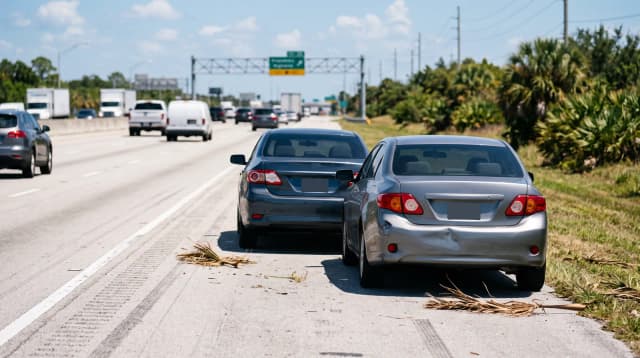
"No-fault" is the most misread phrase in Florida insurance. It does not mean nobody is responsible for the crash, and it does not mean nobody can be sued. It means something narrower and more practical: after most crashes, your own policy pays your first medical bills, regardless of who caused it — and it does that on a deadline that starts running the day of the accident.
The clock is the part that matters
Florida's personal injury protection statute, section 627.736 of the Florida Statutes, sets the benefit at up to $10,000 in medical and disability benefits. That number is on the car insurance page, along with the rest of what Florida requires. This post is about what happens after the crash, which is a different subject.
And what happens after the crash begins with a deadline: benefits are not payable unless the initial services and care are lawfully provided within 14 days of the motor vehicle accident.
Fourteen days. Not fourteen business days, not fourteen days from when you noticed the pain. That is the single most consequential sentence in the statute for an ordinary person, and almost nobody knows it until they have missed it.
Whiplash and soft-tissue injuries are exactly the kind that feel manageable on day one and unbearable on day twenty. If the first visit happens on day eighteen, the argument is no longer about how hurt you are.
What to do with it: get seen. Even if you feel fine, even if the car is drivable, even if it seemed minor. An urgent care visit in the first week is cheap insurance against a fourteen-day rule you cannot appeal.
Your own policy first, whoever caused it
Here is the mechanism people find counterintuitive. You are rear-ended at a light, entirely stopped, entirely blameless — and the policy that pays your first medical bills is yours, not the other driver's.
That is what no-fault does. It routes the first tranche of medical costs through your own coverage so that treatment does not wait for a liability determination that can take months. The trade is speed for simplicity: everyone's own insurer handles their own person, at the start.
Two things follow that people get wrong in opposite directions:
- It does not mean you were not at fault, or that they were not. Fault still exists. It still gets determined. It still matters for what happens next.
- It does not mean your rates are safe. Using your own PIP is a claim on your own policy. What a carrier does with that is a rating decision, and it varies by carrier — which is precisely why comparing matters more after an incident, not less.
What no-fault does not cover, which is most of it
This is where the phrase does the most damage. Personal injury protection is medical and disability benefits with a cap. It is not the whole of the loss, and the parts it leaves out are usually the larger parts.
Your car is not in it. PIP is about people. Damage to your vehicle is handled by other coverages entirely, and whether you have them is a choice you made when you bought the policy.
The other person's car is not in it either. Property damage liability is a separate coverage with a separate limit.
Injuries beyond the cap are not in it. When medical costs exceed what PIP pays, the question of who is responsible comes back — and that is a liability question, answered by bodily injury coverage, which Florida does not require of an ordinary private passenger vehicle. The practical consequence is that the driver who hit you may have no bodily injury coverage at all, legally.
The order of operations after a crash
Not legal advice, and not a claims procedure — carriers have their own. This is the sequence that protects your options.
- Report it, even if it looks small. A crash you agreed to settle privately becomes a problem when the other driver's story changes a week later.
- See a doctor inside the first week. The fourteen-day rule is absolute and the calendar does not care about your reasons.
- Photograph everything before anything moves — positions, plates, damage on both cars, the intersection, the light.
- Get the other driver's insurer and policy number, not just their name and phone. A name without a policy is very little.
- Tell your own carrier promptly, even if you believe the other side will pay. Your policy has notice obligations and they run from the date of loss.
- Keep every receipt and every appointment, including the ones that seemed unnecessary.
None of that is dramatic. All of it is the difference between a claim that proceeds and a claim that argues.
Why the same crash is handled differently by different carriers
The statute sets the floor: the benefit, the deadline, the requirement. It does not set how quickly a company answers the phone, how it handles a disputed treatment, or what it does to your renewal afterwards.
Those are the parts you never see when you buy on price alone, and they are the parts that decide what the experience is actually like. An independent agency sees them across companies rather than one at a time — which is a different thing from a quote.
What this post does not answer
This is an article about how Florida's no-fault system behaves after a crash. It is not legal advice, and it is not a claims procedure.
It cannot tell you whether a specific bill will be paid — that is between your carrier, your provider and your policy. It does not cover what to do about injuries beyond the PIP cap, which is a question for a lawyer, not an agency. And it does not restate what Florida requires you to carry: that is on the car insurance page, with the figures and their source.
Questions we get after an accident
The other driver was clearly at fault. Why is my insurance paying?
Because that is what no-fault means for the first medical costs. Fault has not been erased; it has been moved out of the way so that treatment can start.
I feel fine. Do I really need to see someone?
The statute conditions benefits on initial services within fourteen days of the accident. Feeling fine on day two is common. Discovering otherwise on day twenty is also common, and by then the fourteen days have gone.
Does using PIP raise my premium?
It is a claim on your policy, and how a carrier treats it is that carrier's decision, not a rule. It is one of the things worth asking about before you need to find out.
The other driver had no insurance.
Then the question becomes what your own policy includes for that situation, which is a coverage you either bought or did not. It is worth checking now rather than after.
I was a passenger, not a driver.
The routing question is different and depends on the vehicles and household policies involved. It is exactly the kind of thing to ask before assuming nothing covers you.
Where to start
If you have never read your own auto declarations page past the premium, the useful step is to find out which of these coverages you actually bought — the optional ones are where the difference lives.
Get in touch with We Insure Downtown Miami with your declarations page, or start a coverage review.